

Executive Summary: Launched on July 4, Section 530A accounts, better known as Trump accounts, are a new, IRA-like savings account for children under 18. Though many see them as education accounts, after running the numbers, my take is that these accounts shine brightest as retirement savings tools. I break down how they work, size up realistic balances at 18 and at 60, compare them to typical education and retirement plans—529 plans, UGMA/UTMA accounts and Roth IRAs—and share what I'm doing for my own two kids.
Looking for options when investing for a child? As of July 4, you have a new one: Trump accounts, governed by Section 530A of the Internal Revenue Code. accounts.
530A accounts are IRA-like savings vehicles for children under 18, and IVA readers have understandably had questions—chief among them how they actually work and how they stack up against tools you already know, like 529 plans, UGMA/UTMA accounts and Roth IRAs.
Below, I'll walk through the mechanics, size up what a realistic balance could look like at 18 and at 60 and share what I've decided to do for my own two kids.
But be aware: the rules are still being written and could change. And, as always, I'm not a tax professional and I’m not your financial adviser. If you've got questions about your personal situation, talk to your hired professionals.
What Are Trump Accounts?
Trump accounts, created by last year's One Big Beautiful tax law and launched on July 4, are IRA-like investment vehicles for children under 18.
Here's the quick rundown:
- Available to any child under 18—no earned income required
- Up to $5,000 per year in contributions—but those contributions are not tax-deductible
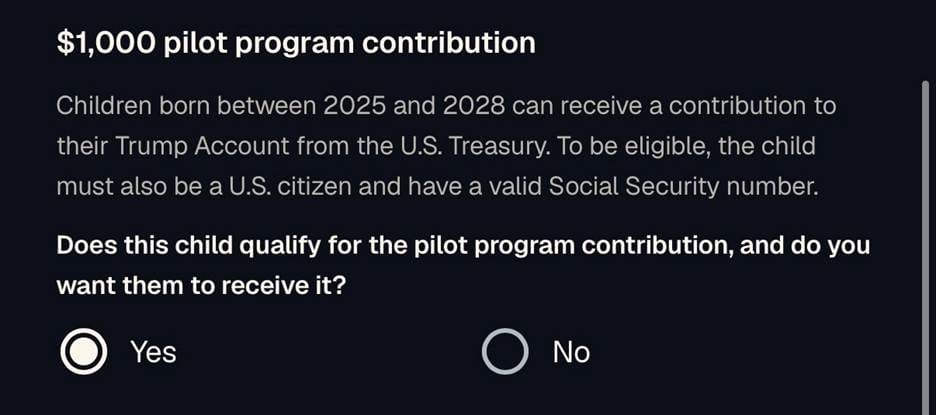
- Children born between 2025 and 2028 are eligible for a one-time $1,000 government contribution (you have to elect it)
- Funds grow tax-deferred and are locked up until the child turns 18
- At 18, the account converts to a traditional IRA, and the child can take control
If this sounds a lot like a mini-IRA without the earned-income requirements, well, that’s about right.
Free Money Available, for Now
Right now, two outside sources are chipping in to new 530A accounts that go beyond your own contributions—and neither counts against the $5,000 annual cap.
The government's $1,000 seed. Every child born between 2025 and 2028 qualifies for a one-time $1,000 U.S. Treasury contribution. But it's opt-in, not automatic—you have to check the box when setting up the account.
If you ask me, that box should be preselected by default; I'd guess the government "saves" real money simply by making people opt in rather than opt out. That's a debate for another day—for now, just remember to check it.
The Dells' $6.25 billion pledge. Billionaires Michael and Susan Dell have pledged $6.25 billion to Trump accounts, earmarked for children born between 2016 and 2024 in zip codes where the median household income is $150,000 or less. Each grant is worth $250—enough to reach 25 million children. It's first come, first served, so check your child's here.
That's the high level. A few quick housekeeping questions, then the details that actually matter for your planning:
How do you sign up? Signing up means filing an IRS Form 4547—through the IRS's Individual Online Accounts (IOLA) site, at tax time or via the Trump Accounts app. I used the app for both my kids; it's not my preferred way to handle financial business (call me old school, but I prefer to use a “big screen” for those tasks), but it worked fine.
Who can contribute? Just about anyone—parents, grandparents, friends—can chip in toward the $5,000 annual cap. Employers can contribute up to $2,500 per employee. The cap starts rising with inflation in 2028, but your last contribution has to land before December 31 of the year the child turns 17.
Do I need to file gift tax paperwork for my contribution? No. The IRS issued a safe harbor in late June clarifying that individual contributions to Trump accounts don't trigger gift tax reporting, as long as you stay under the annual $19,000 gifting exclusion ($38,000 for couples).
How To Invest It
For now, there's exactly one option: State Street's SPDR Portfolio S&P 500 ETF (SPYM)—not to be confused with its pricier, more heavily traded sibling, SPDR S&P 500 ETF (SPY).
However, that's about to change. The Treasury Department plans to expand the lineup to include Vanguard's Total Stock Market ETF (VTI) and three other U.S.-only stock ETFs, all charging 0.03% annually.
| Fund | Ticker | Expense Ratio |
| State Street SPDR Portfolio S&P 500 ETF | SPYM | 0.02% |
| iShares Core S&P 500 ETF | IVV | 0.03% |
| Vanguard Total Stock Market ETF | VTI | 0.03% |
| State Street SPDR Portfolio S&P 1500 Composite Stock Market ETF | SPTM | 0.03% |
| iShares Core S&P Total Stock Market ETF | ITOT | 0.03% |
I plan to switch to Total Stock Market ETF once it's available, though all four funds get you to the same destination. (I’m willing to pay a single additional basis point to own the entire haystack instead of just 500 stocks.)
Withdrawal Rules and Rights
You generally can't touch the money in a 530A account before 18, aside from narrow exceptions for certain rollovers, death or excess contributions. On January 1 of the year a child turns 18, the account becomes a traditional IRA—in their control, not yours.
From there, standard IRA rules apply, with one meaningful twist: your own contributions come out tax-free, since they were made with after-tax dollars. But you can't isolate that money and withdraw it on its own—every distribution is a pro rata mix of your contributions and the taxable pool (the $1,000 seed, any employer or charity money and all investment earnings).
Whatever comes out, part of it is taxed as ordinary income—plus a 10% penalty if withdrawn before 59½, waived under the usual IRA-type exceptions (education, a first home and others).
The Financial Aid Wildcard
Here's a "big" one we don't know yet: how Trump Account assets will affect financial aid eligibility. The Department of Education hasn't weighed in.
If treated like a UGMA/UTMA account (a "student" asset), it'll count against need-based aid. If treated like a retirement account, it won't need to appear on the FAFSA at all.
As I said, these are brand new accounts, and the rules are still being written.
How Big Could a 530A Become?
So, how much money are we talking about?
The ultimate size of any Trump Account, like most other savings accounts, is going to depend on three factors:
- How much money is contributed
- How long the money is invested
- What returns are earned