

Executive Summary: TIPS yields haven't looked this good in years—but buying them is still a maybe. I break down how inflation-protected bonds work, what's driving the improvement and why I still rate all three Vanguard options a Hold—though I’ve got a clear preference.
As I’ve been digging into Vanguard’s bond funds over the past few weeks, the number one question I’ve heard from IVA readers is about Treasury Inflation-Protected Securities (TIPS). As one reader put it:
TIPS seem like a good alternative, with the ability to lock in higher yields plus an inflation adjustment. What are your thoughts?
As I move beyond Vanguard's core, investment-grade bond funds (see here and here) to its other options, I'm setting my sights on TIPS first—and the timing is good given growing inflation worries. In today’s article, I’m going to try to answer two questions:
Are TIPS a good buy today? And, if so, which Vanguard fund should you choose? But first, some basics.
How Inflation Funds Work
As the name implies, Treasury Inflation-Protected Securities are Treasury bonds with an inflation-indexed twist. Like traditional Treasurys, they carry no default risk, as the U.S. Treasury pays interest on schedule and returns full face value (plus, in the case of TIPS, any inflation-related adjustments) at maturity. Every six months, the bond’s principal adjusts based on the inflation rate.
When inflation rises, the principal rises with it. Since the coupon (or interest) rate stays fixed, that interest on the higher principal means a larger payout—keeping the bond’s real return, or return after inflation, roughly constant.
In periods of deflation, the principal adjusts down and income falls, but at maturity the Treasury pays back the higher of the adjusted or original principal, so you're protected on the downside.
Let me put this into numbers.
Say you buy a one-year TIPS bond for $1,000, yielding 2%. Your first semiannual payment is $10 (or half of 2% on $1,000). If inflation then runs at 4%, the Treasury adjusts your $1,000 principal to $1,040—pushing your next payment to $10.40. At maturity, you get $1,040 back, not $1,000.
If inflation fell 4% instead of rising 4%, the Treasury would adjust your $1,000 principal to $960. Your next interest payment would drop to $9.60, but you’d get the full $1,000 principal back at maturity.
It sounds pretty simple, but here are four critical points to remember about TIPS.
First, despite their unique inflation adjustments, TIPS are still bonds, so interest-rate moves affect their price—not just inflation.
Inflation-Protected Securities (VIPSX) holds longer-maturity bonds (7.1 years on average) and is quite rate-sensitive. In 2022, even as its interest payments rose 35% as inflation was rising toward 9%, the inflation fund’s price fell nearly 20%, and its total return was a 12.0% loss for the year.
Second, TIPS are less liquid than plain Treasurys. During the 2008 credit crisis, Inflation-Protected Securities didn't benefit from investors' flight to safety. Investors wanted Treasurys, not TIPS—and the inflation fund lost 12.5% over seven months, even though its portfolio was 100% government-backed bonds.
Third, TIPS are tax-inefficient. Since both income and principal adjustments are taxable each year, they're best held in tax-deferred accounts like an IRA.
Fourth, TIPS are tied to the Consumer Price Index (CPI), which measures price changes across the economy. The inflation rate you experience may differ depending on the goods and services you buy, so the inflation adjustment may not cover your own rising costs over time.
Locking In a Real Return
TIPS are getting attention today because inflation is rising, the Federal Reserve is under pressure to raise interest rates and inflation bonds are offering investors guaranteed inflation-beating returns.
Consider the chart below tracking Inflation-Protected Securities’ (VIPSX) monthly SEC yield since its inception more than 25 years ago. (For now, let’s focus on Vanguard’s oldest inflation fund for the longest perspective.)

No, your eyes are not deceiving you. The fund’s reported yields have at times been negative. That’s because the fund reports a "real" yield—the yield after inflation. If the yield was zero, the fund was priced to match inflation; a positive yield meant inflation-beating returns; a negative yield meant the fund was falling short.
The next chart plots Inflation-Protected Securities' SEC yield against its actual inflation-adjusted return over the following 10 years (chosen to match the fund's average maturity since inception). The two lines track closely—meaning the fund's current yield is a decent predictor of its future real (after inflation) return.
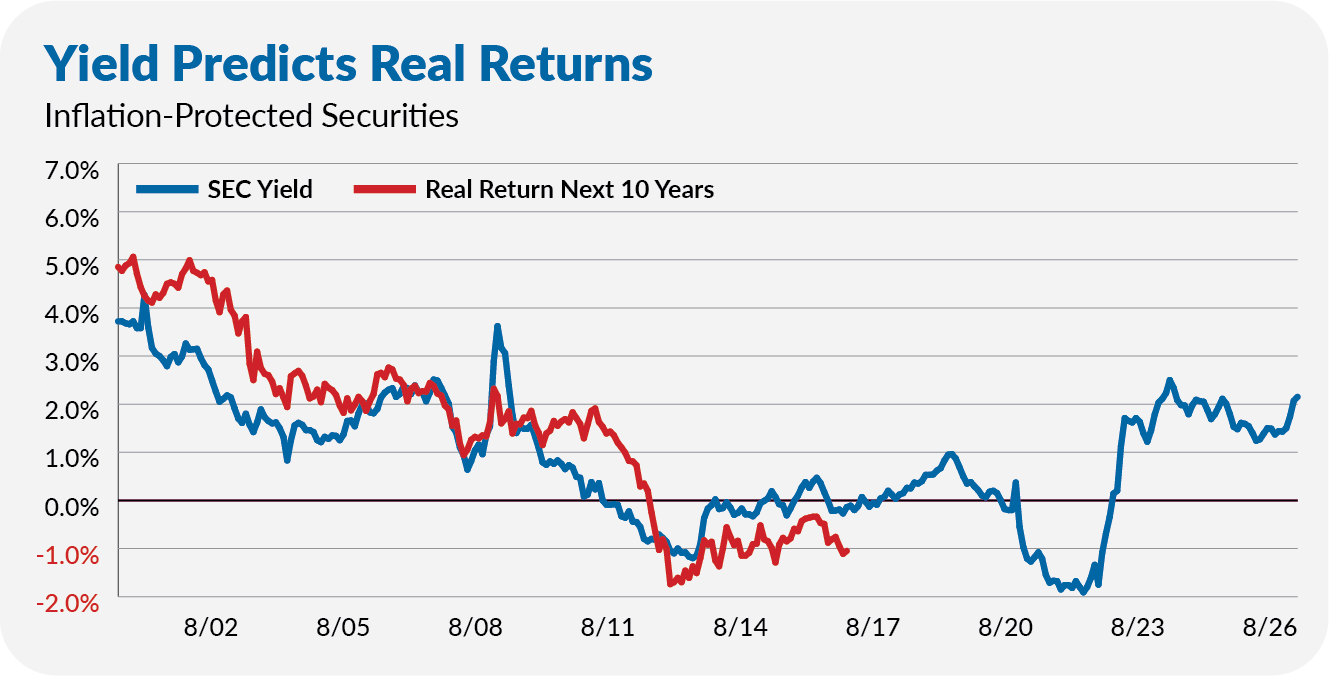
For most of the 2010s, inflation funds were priced to match or trail inflation—not a compelling proposition. Today, they are priced to beat inflation by around 2%. That's a better story.
But let’s put that inflation-beating 2% in context.