

Hello, and welcome to the IVA Weekly Brief for Wednesday, August 26.
There are no changes recommended for any of our Portfolios.
Scheduling Notice: When a month starts on a Tuesday, two Premium emails land on top of each other—the Monthly Recap (first business day) and IVA Research (Tuesdays). I've sent them together in the past. Next week I'm giving each its own day so neither gets short shrift:
- Tuesday, September 1 — Monthly Recap (Premium Members)
- Wednesday, September 2 — Weekly Brief (as always)
- Thursday, September 3 — IVA Research (Premium Members)
Last week, I made the case for patience, using this year’s choppy but market-beating returns from U.S. Momentum Factor ETF (VFMO) and Capital Opportunity (VHCOX) as lessons.
This week the calendar hands me a much longer example.
On Monday, Vanguard’s First Index Investment Trust—better known as 500 Index (VFINX, the original Investor share class)—turns 50.
From its 1976 inception through Tuesday’s close, 500 Index has returned 25,235%, or 11.7% a year. A $5,000 investment at the fund’s inception—which shrank to $4,700 after a 6% sales load—would be worth nearly $1.2 million today. (That load, charged by brokers, disappeared almost immediately when Vanguard changed to a no-load distribution strategy in early 1977.)
Compounding at nearly 12% annually for five decades pays off. But don’t let anyone tell you it was easy money.
Early shareholders who collected those returns had to watch their fortunes ebb and flow through wars, recessions and more recently, a pandemic. They rode bubbles up and then back down—a one-day 20% crash in 1987, a 45% decline during the dot-com bust, a 51% collapse courtesy of the financial crisis, a 34% drop in five weeks in 2020 thanks to COVID. Every one of those declines seemed, at the time, like a good reason to sell.
Nor was the index fund an obvious winner at its start. The launch was a flop. Vanguard hoped to raise as much as $150 million and took in a little over $11 million. Critics called it Bogle's Folly, and for a while it looked like they had a point.
Today, investors hold more than $2 trillion in 500 Index across its multiple share classes (and institutional versions), and indexing is the default choice for most Americans saving for retirement.
The bottom line: 500 Index's first 50 years are a testament to spending time in the market, staying diversified and keeping costs low. None of those require you to be clever; only to be patient. Following those principles is likely to reward you over the next 50 years as well.
Vanguard Finally Locks It Down
A year ago, I warned you about ACATS (Automated Customer Account Transfer System) fraud—where a criminal impersonates you, opens an account at another brokerage firm, and submits a request to pull the money out of your real account. ACATS is the plumbing that moves assets between brokerage firms.
Well, ACATS fraud is back in the news. Last week, Senators Ron Wyden and Elizabeth Warren sounded the alarm, writing to FINRA, the brokerage industry’s self-regulator, demanding tougher standards.
When I wrote about this last October, Vanguard had no simple way to lock your account to prevent an ACATS transfer. The process was clunky at best. You had to mail a signed letter to a P.O. box in Texas. My conclusion then: “It's time to give shareholder-owners the same kind of protection competitors already offer.”
Well, Vanguard has done it—and the senators noticed. Their letter names Fidelity and Vanguard as the two firms that currently let customers block outgoing transfers themselves.
I’m here to tell you how you can switch that lock on yourself, online, in about a minute.
Here's the process. Log in, then go to your Security profile.
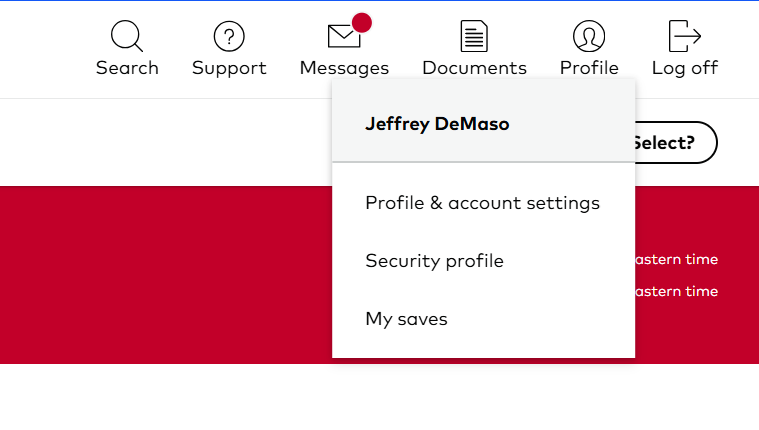
When I visited the security page, locking my accounts was the top recommendation.
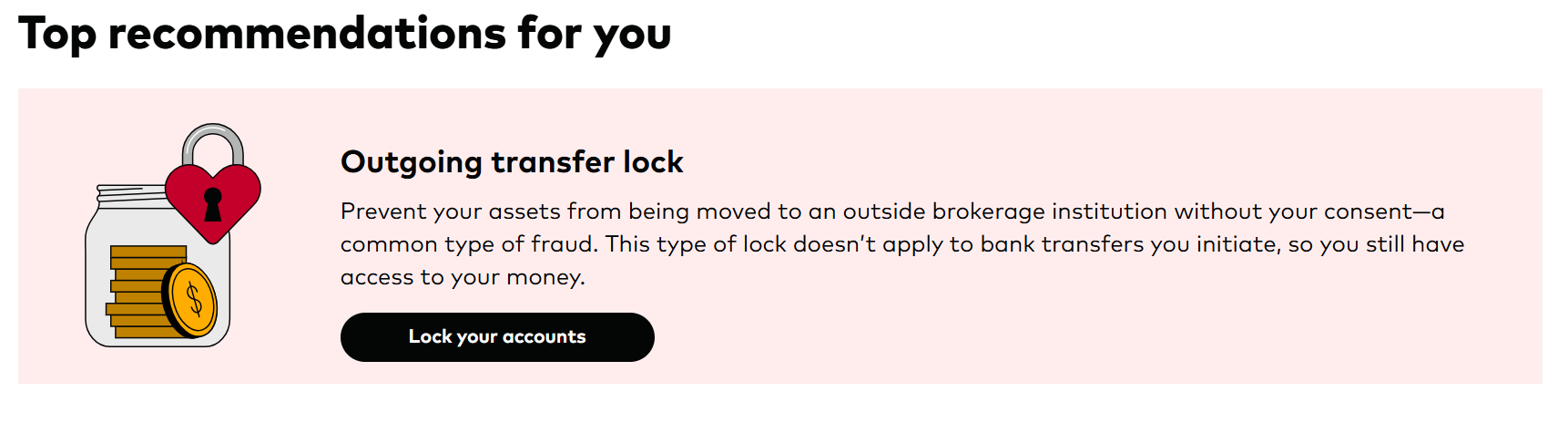
If you don't see it there, look further down for what Vanguard calls the outgoing transfer lock. From there, follow the prompts—the steps were easy enough.
Locking your account prevents transfers other firms initiate (like ACATs)—it does not block bank transfers you start yourself. You’ll still have access to your money without having to toggle the lock on and off constantly.
Be aware that the lock is off by default. Vanguard added it recently, but quietly. So, nothing happens until you make the effort to turn it on.
Vanguard says a “full transfer lock” is coming soon. I’ll report back when I learn what it covers.
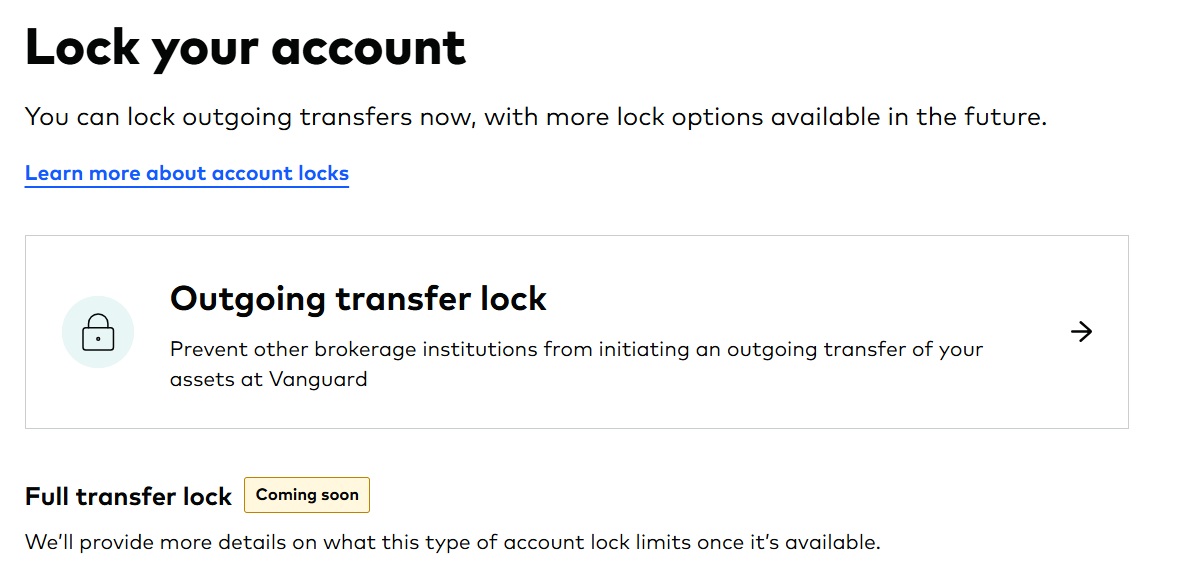
The bottom line: Vanguard should have offered this a year ago, and it should have told you when it finally did. But it's here, it's free, and it takes a minute. Go lock it down.
Vanguard Buys Back In
Vanguard walked away from the advisor custody business in 2003. This week it bought its way back in, agreeing to acquire Altruist, a custody platform for registered investment advisors—the independent firms that manage money for clients.
Custody is the plumbing of the advice business—holding assets, settling trades and producing statements. While Schwab and Fidelity dominate it, Altruist is a much smaller, newer challenger built around its own technology.
The two firms aren't strangers—Vanguard first invested in Altruist in 2020. Now it's buying the whole thing. The terms, like how much Vanguard paid, weren't disclosed. Altruist keeps its name, its leadership under founder Jason Wenk and its own way of operating; it just does so with Vanguard's balance sheet behind it.
Why bother? Vanguard’s prize is distribution. Advisors decide where trillions of client dollars go, and the more of them running on Vanguard's plumbing, the more of that money likely lands in Vanguard funds. Pair this with Vanguard's move earlier this month to let advisors customize their model portfolios, and a pattern emerges: CEO Salim Ramji sees the advisor channel as Vanguard's next big pool of assets.
What does this mean for you? Directly, nothing—not today. If you’re a Personal Advisor client, you may eventually see Altruist's technology in your experience, ideally for the better.
One note of caution. Vanguard's first outside acquisition—direct-indexing firm Just Invest in 2021—went badly, leading the founders to sue Vanguard four years later. Because Altruist will keep operating on its own, I expect this one to go better. Granted, that's a low bar.
Our Portfolios
Our Portfolios are showing solid returns for the year through Tuesday. The Aggressive Portfolio is up 16.7%, the Aggressive ETF Portfolio is up 14.1%, the Growth Portfolio is up 14.7%, the Moderate Portfolio is up 13.5% and the Conservative Portfolio is up 8.1%.
This compares to a 13.5% return for Total Stock Market Index (VTSAX), a 17.2% gain for Total International Stock Index (VTIAX), and a 0.4% return for Total Bond Market Index (VBTLX). Vanguard’s most aggressive multi-index fund, Target Retirement 2070 (VSNVX), is up 13.6% for the year, and its most conservative, LifeStrategy 20/80 (VASIX), is up 3.4%.
IVA Research
Yesterday, I answered a common IVA reader question: If cash yields about as much as bonds with none of the risk, why own bonds at all?
Until my next IVA Weekly Brief, have a safe, sound and prosperous investment future.
Still waiting to become a Premium Member? Want to hear from us more often, go deeper into Vanguard, get our take on individual Vanguard funds, access our Portfolios and Trade Alerts, and more? Start a free 30-day trial now.
Vanguard and The Vanguard Group are service marks of The Vanguard Group, Inc. Tiny Jumbos, LLC is not affiliated in any way with The Vanguard Group and receives no compensation from The Vanguard Group, Inc.
While the information provided is sourced from sources believed to be reliable, its accuracy and completeness cannot be guaranteed. Additionally, the publication is not responsible for the future investment performance of any securities or strategies discussed. This newsletter is intended for general informational purposes only and does not constitute personalized investment advice for any subscriber or specific portfolio. Subscribers are encouraged to review the full disclaimer here.