

Hello, and welcome to the IVA Weekly Brief for Wednesday, November 25.
There are no changes recommended for any of our Portfolios.
AI chipmaker NVIDIA’s soap opera has been something to behold. Founder and CEO Jensen Huang was fired on November 11 after admitting to two affairs: one with a subordinate, and one with a customer with potential ties to security organizations in China.
Over the next seven trading days, NVIDIA's stock lost 28%—more than $1 trillion in market value. Then, under pressure from the White House, Huang was reinstated over the weekend, and the stock jumped 25% on Monday, recouping nearly $1 trillion in market value.
I'm not a stock analyst, and I won't try to put a value on NVIDIA. But the market's verdict is hard to miss: Traders priced one man at roughly a quarter of the company's worth—and his return sent AI stocks broadly higher, lifting 500 Index (VFIAX) 4.7% on Monday. That's a good measure of how much today's market rides on the AI trade.
And it’s not exactly confidence-inspiring. I'm a big believer in diversification, and having that much of the market riding on one person's shoulders rubs me the wrong way.
Does that mean I'm heading for the exits or abandoning my time-in-the-market approach? Absolutely not. Because, in fact, time in the market cures many short-term ills.
As of Friday's close—before Huang got his job back—500 Index was 11.5% below its October 6 high-water mark, putting it officially in correction territory. Information Technology ETF (VGT) was in a bear market, down 24.7%.
Corrections and bear markets are inevitable. They're the price of admission for compounding your wealth in the stock market.
Consider the chart below. It plots 500 Index's return for each calendar year alongside its biggest peak-to-trough drop during that year. Since 1984 (as far back as my daily data goes), the fund has had a correction (a decline of 10% or more) about one year in two, and a bear-market-level drop (20% or more) about one year in six.
The average intra-year decline is roughly 14%. Yet, 500 Index finished with a gain in 36 of those 43 years and is up 10,750% including dividends over the period. That’s 11.5% per year.
In other words, this correction is, so far, entirely ordinary. It's actually a bit milder than the typical year's worst drop.
Of course, every bear market starts out as a correction, and no one can tell you in real time whether this one stops here or keeps going.
If recent market moves have you questioning your portfolio, these two Premium articles dig into the history of corrections, bear markets and recoveries:
The bottom line: Time in the market can compound your wealth, but you'll never hear me say it's easy. Own a resilient portfolio that fits your goals, risk tolerance and investment style. That's what I do with my own money.
Schroders' Reprieve Lasts a Week
Last week I told you that Vanguard's board had signed a new agreement with Schroders to keep running part of International Explorer (VINEX)—for the sake of continuity—even though Vanguard's own manager-oversight team was "concerned" about Schroders' performance.
Well, that continuity lasted about a week.
On Monday, Vanguard sent Schroders packing. The fund's original manager is being replaced by Vanguard's in-house quantitative team, with Cesar Orosco and Sharon Hill co-managing 35% of the portfolio. The remaining 65% stays with Wellington's team of industry analysts, overseen by Mary Pryshlak.
What does this mean for shareholders? Lower costs, for one: The expense ratio is expected to fall from 0.46% to 0.41%. That's a small win.
But I also expect International Explorer to look more like its index from here. Vanguard's quant team tends to run portfolios close to the benchmark, and adding a broadly diversified second sleeve dilutes any bold bets. Shareholders should do fine—but why pay an active fee for something that behaves like an index fund?
International Explorer remains a Hold—nothing more, nothing less.
BondBuilder Adds a Rung
In March, Vanguard launched ten Target Maturity Corporate Bond ETFs under the BondBuilder name. The ETFs are designed to make building a diversified bond ladder easy. But a bond ladder only works if you can keep adding rungs: When your nearest ETF matures, you reinvest the proceeds at the far end. That requires Vanguard to launch a new ETF each year.
Vanguard is doing just that. It filed paperwork with the SEC to launch Target Maturity 2037 Corporate Bond ETF (VBCK), which is expected to begin trading on February 25, 2027.
Premium Members can read my full take on these ETFs—what they are, where they fit and how to use them—in Vanguard's Target Maturity Bond ETFs: Useful Tools, Limited Uses.
Scam Alert
An IVA reader forwarded me a scam email from a Vanguard imposter. Look closely at the sender: "vangaurdregulatory.com." Vanguard is misspelled, and Vanguard's emails come from vanguard.com—not a made-up "regulatory" domain.
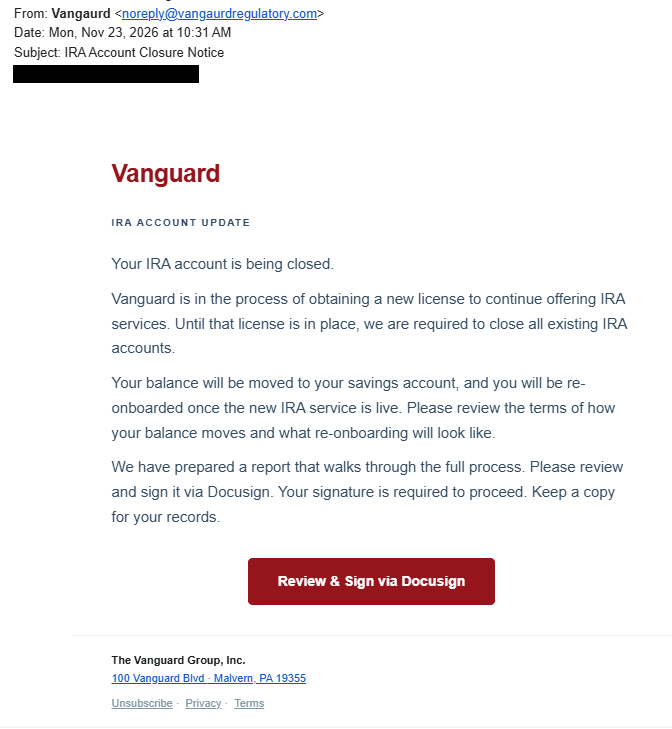
The subject line—"IRA Account Closure Notice"—is designed to scare you. But the story doesn't hold up. Vanguard doesn’t have an IRA license to lose and would never close every IRA.
So, no, Vanguard isn't going to close your IRA and move the money to a savings account. That would count as a withdrawal, triggering income taxes and possibly a 10% early-withdrawal penalty.
The fake urgency and "sign via DocuSign" button are how these scams harvest your login or personal details.
If you get an email like this, do NOT click any links.
Unfortunately, AI means scammers will only get better, with more convincing, realistic-looking emails. If something seems off, log in to your account directly by typing vanguard.com into your browser, or call Vanguard on a number you trust, not one listed in the email. Vanguard's general line is 877-662-7447.
Our Portfolios
Our Portfolios are showing positive returns for the year through Tuesday. The Aggressive Portfolio is up 7.7%, the Aggressive ETF Portfolio is up 5.7%, the Growth Portfolio is up 7.5%, the Moderate Portfolio is up 7.7% and the Conservative Portfolio is up 5.5%.
This compares to a 6.4% return for Total Stock Market Index (VTSAX), a 3.8% gain for Total International Stock Index (VTIAX), and a 0.4% decline for Total Bond Market Index (VBTLX). Vanguard’s most aggressive multi-index fund, Target Retirement 2070 (VSNVX), is up 4.9% for the year, and its most conservative, LifeStrategy 20/80 (VASIX), is up 1.1%.
IVA Research
Yesterday, I showed Premium Members why buying a fund right before its year-end payout won't make you richer—but could make you poorer.
Until my next IVA Weekly Brief, have a safe, sound and prosperous investment future and very happy Thanksgiving.
Still waiting to become a Premium Member? Want to hear from us more often, go deeper into Vanguard, get our take on individual Vanguard funds, access our Portfolios and Trade Alerts, and more? Start a free 30-day trial now.
Vanguard and The Vanguard Group are service marks of The Vanguard Group, Inc. Tiny Jumbos, LLC is not affiliated in any way with The Vanguard Group and receives no compensation from The Vanguard Group, Inc.
While the information provided is sourced from sources believed to be reliable, its accuracy and completeness cannot be guaranteed. Additionally, the publication is not responsible for the future investment performance of any securities or strategies discussed. This newsletter is intended for general informational purposes only and does not constitute personalized investment advice for any subscriber or specific portfolio. Subscribers are encouraged to review the full disclaimer here.