

Correction (October 27): The original table omitted per-share gains for Admiral shares of 19 funds. The table has been updated. Percentages of NAV and all conclusions are unchanged.
Executive summary: Vanguard’s actively managed stock funds are on pace to pay their largest capital gains distributions since at least 2004, averaging nearly 10% of NAV. Index funds and ETFs are again paying almost nothing. I break down which funds are paying, how much, what it means for the IVA Portfolios and how to plan for it.
Profits have been building as the current stock bull market has rolled on. One result: Capital gains distributions have grown three years in a row and are on track to set a record in 2026.
Through September 30, Vanguard’s actively managed U.S. and international stock funds had booked realized gains averaging 9.6% of their net asset value (NAV). That’s the highest figure in my records, which go back to 2004. The previous high was 8.1% in 2021, and the average since 2004 is 3.6%.
The chart below shows the average capital gains distribution for Vanguard’s actively managed stock funds each year.1 This year’s figure is based on realized gains through September.
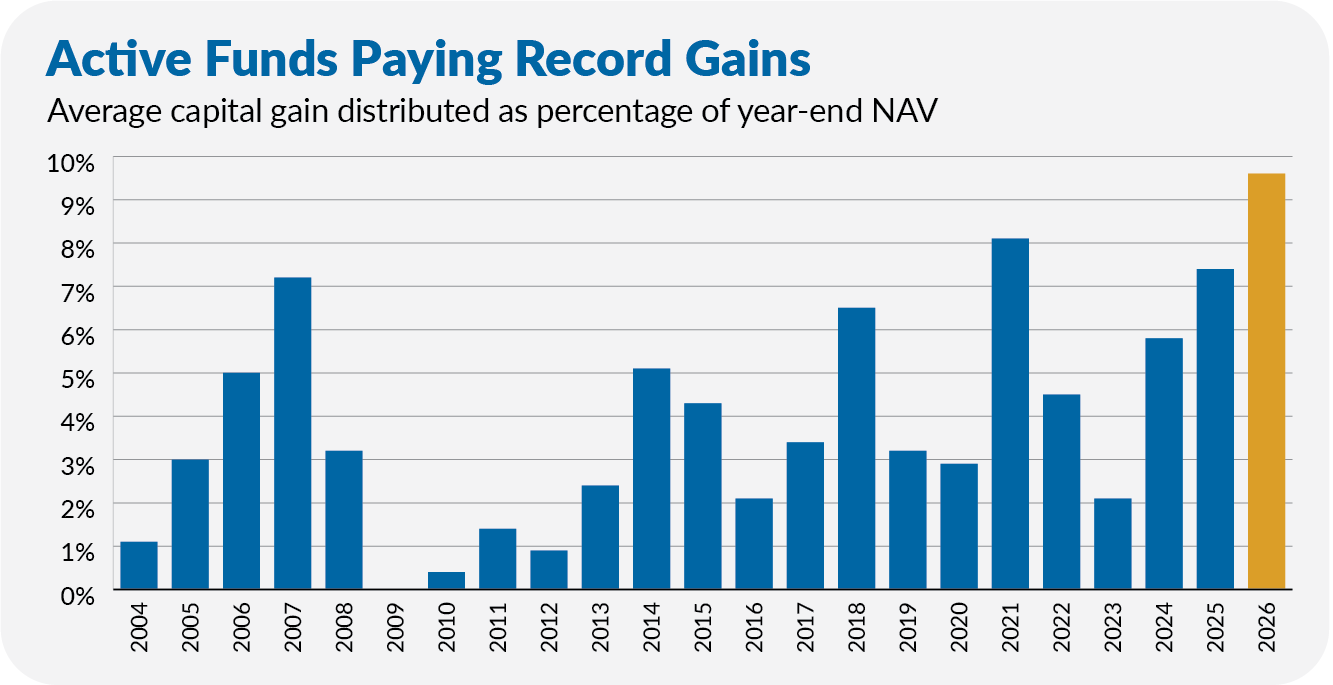
Sixteen funds are on pace to pay out 10% or more of NAV. But that’s an active-fund story. Vanguard’s stock index funds and ETFs, by contrast, have booked essentially no gains. (I’ll point out the exceptions shortly.)
Vanguard won’t publish official estimates until mid-November, but you don’t need to wait to start planning.
If you need a refresher, my Capital Gains 101 and Capital Gains 102 articles cover the details. Here are the essentials:
Every December, Vanguard (like every fund company) must pass along the interest, income and trading profits (capital gains, in tax-speak) its funds earned during the year. If you own a fund on its record date, you receive the distribution.
Those gains are taxable even if you reinvest them. (Funds held in IRAs, 401(k)s and other tax-deferred accounts aren’t affected.)
How to Read the Table
Vanguard publishes monthly updates on each fund’s realized gains. I’m not aware of any other fund firm that does this, and Vanguard deserves credit for this level of transparency.
That makes this year’s change all the more frustrating. My go-to source for Vanguard’s official estimates, the tax center on its advisor site, is now locked… unless you’re an advisor. I don’t see the data anywhere on Vanguard’s investor site.
Vanguard has told me it will share the estimates with me, and I’ll pass them along when I have them. But if they don’t end up somewhere individual investors can easily find them, Vanguard is dropping the ball. This information matters as much to DIY investors as it does to advisors. Owners deserve better.
Fortunately, the monthly realized-gains figures are the next best thing. They give a fairly reliable read on December payouts. The numbers can shift between September and year-end, but usually not by much unless something big happens like a manager change or a sudden wave of redemptions that forces a fund manager to do a lot of selling.
The table below lists every Vanguard fund with net realized gains as of September 30. If a fund isn’t listed, its realized losses outweighed its gains through the third quarter, and I wouldn’t expect a capital gains distribution (or at least not a sizeable one).
For each fund, I show the per-share dollar gain and that gain as a percentage of the fund’s September 30 price.