

Dividend Growth (VDIGX) needs a refresh, but will the current changes be enough?
According to Dividend Growth’s new co-managers, Tom Levering and Tim Casaletto, the once index-beating fund went awry over the past few years because it was managed too conservatively. The active fund was tame even compared to its already defensive benchmark, the S&P U.S. Dividend Growers Index, which Dividend Appreciation Index (VDADX or VIG) tracks.
In short, the fund wore a belt and two pairs of suspenders when the belt alone would have done.
My bottom line: The managers' ideas for making the fund a winner again make sense. If you've held on to Dividend Growth to avoid realizing a large gain as I have, I see no reason to change course. (A trust I oversee is sticking with it.)
But I wouldn't buy it today. The managers said several times that they like the "beta" of dividend growers, which is investor-speak for the return of the index itself. You can get that directly with Dividend Appreciation Index.
To earn their keep, Levering and Casaletto need to beat the index after fees. That's a high bar, and it's too early to say whether they'll clear it.
The full interview follows, but here are a few thoughts on what's changing:
Fewer macro bets. Under the old management, most of the fund’s risk came from sector and factor bets while only about a quarter of the fund's risk relative to its benchmark came from stock selection.
The new managers want to flip that: Stay close to the index on sectors and risk while letting stock-picking drive results.
Wellington Management colleague Ken Abrams instilled the same approach at International Core Stock (VWICX) before he retired, and it has worked well there so far.
A quicker trigger on fading companies. Diageo and Nike were great businesses that stopped being great, and the team held on too long. Former manager Peter Fisher flagged the same weakness but didn’t sell fast enough.
A slightly wider net. As I noted last week, the managers will now consider companies that don't pay a dividend but are buying back stock. That adds only about 40 stocks to a universe of roughly 500, and the fund owns just one of them today.
More telling is a new willingness to own cyclical and foreign stocks: they’ve already stocked up on J.P. Morgan, increased energy stocks to benchmark weight and added more non-U.S. companies.
The managers aren't short on ambition. Over the past decade, dividend growers trailed the broad market by about two percentage points a year, and Dividend Growth trailed its benchmark by roughly another two. Levering expects the first gap to reverse and plans to close the second himself. "Our goal is to take that index fund and make [it] look foolish," he said.
The managers are also putting their money where their mouths are. Casalletto has all of his retirement assets in Dividend Growth, and Levering owns both the mutual fund and its sibling, Wellington Dividend Growth Active ETF (VDIG).
First, an update on Levering's record at Energy Opportunities. Then my full conversation with the managers. Since this is a digital newsletter, not print, I've edited it lightly and let it run long. The managers were generous with their time, and you, as an IVA reader, benefit from that.
Update: Levering's Record at Energy Opportunities
Last week, I compared Energy Opportunities (VGENX) to a 50/50 mix of Energy ETF (VDE) and Utilities ETF (VPU). I concluded that Levering had "delivered mostly index-like returns since the reboot nearly six years ago."
That's accurate but incomplete. The fund's official benchmark isn't that mix of ETFs. It's the MSCI ACWI Energy + Utilities index, a global index of energy and utilities stocks. Against that yardstick, Energy Opportunities has outperformed by more than five percentage points a year. That's impressive.
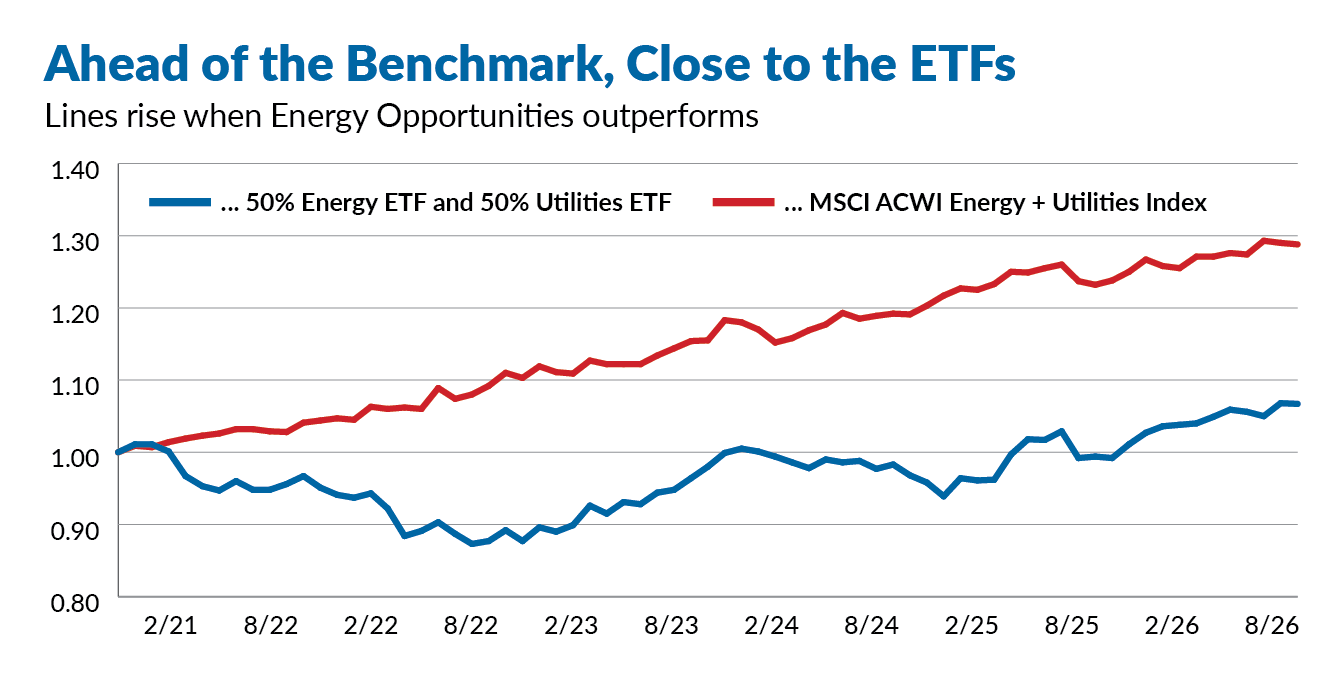
So, both things are true. Levering has beaten the benchmark he's paid to beat. But an investor who simply owned Vanguard's two sector ETFs beat it as well.
At Dividend Growth, that ambiguity goes away. The fund's benchmark is the same index that Dividend Appreciation Index tracks, so beating the benchmark is beating the low-cost index fund and ETF alternative. Levering's record at Energy Opportunities is encouraging for Dividend Growth shareholders.
Without further ado, here is my conversation with Wellington Management’s Tom Levering and Tim Casaletto: