

Executive Summary: Dividend Growth's new managers have turned over about 20% of the portfolio, added mega-bank JPMorgan and upped allocations to energy and utilities stocks. The fund's defensive profile remains intact. If you've avoided selling for tax reasons (a lot of us have big embedded capital gains in this fund), sit tight until I interview the managers.
Dividend Growth (VDIGX) is under new management, and IVA readers who still own the fund want to know what that means for them.
My early read: The fund is undergoing an evolution, not a revolution. In their first two months, the new managers are taking a measured approach to recasting the portfolio in their vision—roughly three-quarters of the fund’s assets remain in stocks they inherited. However, a few of their moves break with the old playbook.
If you're holding Dividend Growth to avoid realizing a large gain, as I am, nothing I've seen so far calls for action. Sit tight.
My upcoming interview with the new managers, Tom Levering and Tim Casaletto, will round out the story. In the meantime, here's the research I've done to prepare, along with the questions I plan to ask.
Note: This morning, before I hit send on this article, Vanguard shared an interview with the managers; you can find it here.
Background
Dividend Growth became the fund we know today in February 2006, when Wellington Management's Donald Kilbride took over as manager. Once a utilities fund, Kilbride’s mandate was straightforward but demanding: Invest in companies with both the ability and the willingness to grow their dividends over time.
Executed well, it proved a winning formula. Over Kilbride's tenure (2006–2023), a period that included the Great Financial Crisis and the COVID bear market, Dividend Growth outpaced 500 Index (VFIAX) 449% to 430%, with less volatility. That's no small achievement.
The fund was a mainstay of the IVA Portfolios for more than a decade. But last year, lagging results, a leadership transition and an effective index-fund substitute tipped the scales, and I moved the Portfolios from Dividend Growth to Dividend Appreciation Index (VDADX).
Vanguard and Wellington eventually reached a similar conclusion, or at least decided a reset was in order. In July, they replaced Kilbride's chosen successor, Peter Fisher, with Levering and Casaletto.
Two months in, here's what we know about the new team and what they've done with the portfolio.
The New Managers
Levering is the senior hand. He has managed Energy Opportunities (VGENX), Vanguard’s recast energy sector fund, since January 2020 and has spent more than two decades focused on utilities and energy infrastructure.
His record there comes with a wrinkle. In October 2020, Vanguard overhauled the fund. It dropped the internal quant team that ran a small slice of the portfolio, left Levering as sole manager and swapped the pure-energy benchmark for the MSCI ACWI Energy + Utilities Index. Renaming the fund Energy Opportunities in May simply made the broader mandate official.
So, as the chart below shows, it's no surprise the rebooted fund has tracked a 50/50 blend of Energy Index (VENAX) and Utilities Index (VUIAX). Energy Opportunities has beaten Utilities Index, which is up just 61% since the overhaul, but it has failed to keep pace with Energy Index, which is up 469% over the same stretch—Vanguard’s timing in broadening the mandate beyond traditional energy stocks couldn’t have been much worse.
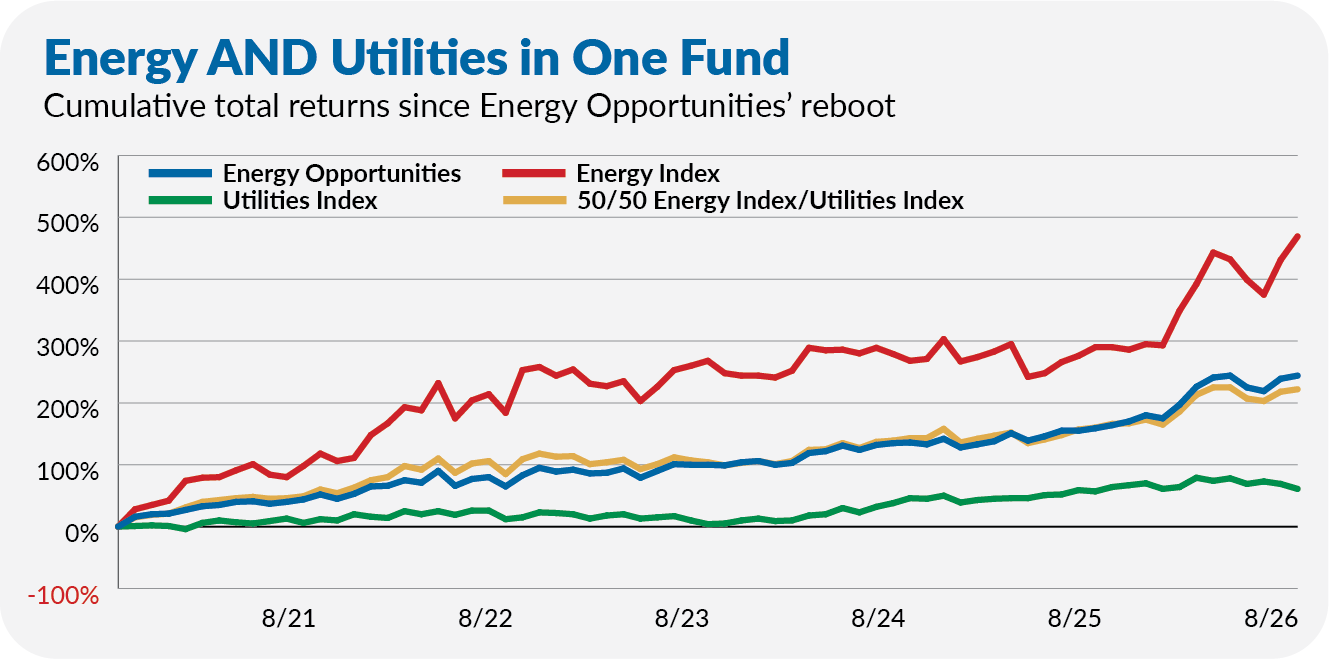
Yes, Energy Opportunities has beaten the blend 244% to 222%, an edge of about 1.4 percentage points a year. But the advantage was all built in the last 12 months. In short, Levering has delivered mostly index-like returns since the reboot nearly six years ago.
That matters here. Last year, I traded Dividend Growth for Dividend Appreciation Index precisely because an index fund could do the job Dividend Growth was not doing. For Levering and Casaletto, index-like results won't cut it. The bar is beating Dividend Appreciation Index over a full market cycle.
Casaletto spent a decade working alongside Levering—including when Energy Opportunities was rebooted in 2020—before joining the Dividend Growth team in 2025, so the pairing isn't random. Encouragingly, as of the end of April, Casaletto had between $100,000 and $500,000 invested in the fund. Hopefully, Levering will follow his lead.
The two have also reshaped a strategy together before. As we'll see, the changes at Dividend Growth are more modest, but they're real.