

Stocks are expensive. That much is clear.
But expensive doesn’t mean undesirable. A Rolex is many times more expensive than a Swatch—and yet demand for Rolex watches still outstrips supply.
As investors, the question isn’t what to do about expensive watches. It’s what to do about expensive stocks.
Here’s a recent note I received that captures what many of you have been asking:
I read that the CAPE is near a record high. Should I move to safer investments? Sell stocks and buy bonds?
Let’s start with a quick translation.
CAPE—short for cyclically adjusted price-to-earnings ratio—was popularized by Yale professor Robert Shiller, who built a database of stock prices going back to the 1870s. The CAPE compares current stock prices to inflation-adjusted earnings over the prior decade, smoothing out the ups and downs of the business cycle.
By that measure, the market is stretched. CAPE currently sits above 39—a level only seen once before, at the peak of the late-1990s tech bubble.
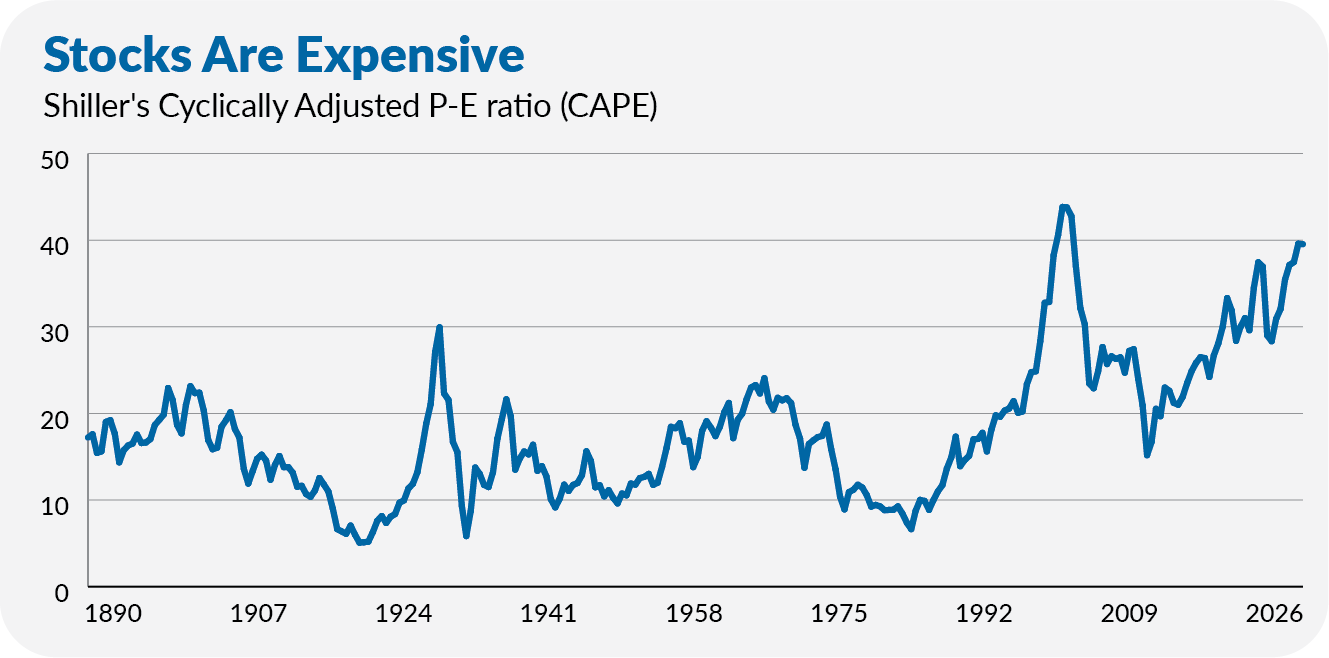
That looks and sounds ominous.
But before making portfolio decisions based on today’s CAPE statistics, we need to answer an important question:
Does the CAPE level tell us anything about the stock market’s future returns?