

Hello, and welcome to the IVA Weekly Brief for Wednesday, February 25.
There are no changes recommended for any of our Portfolios.
The U.S. economy grew at a relatively slow 1.4% annualized pace in the fourth quarter, pushing Gross Domestic Product (GDP) to a record $24.1 trillion. The government shutdown may have weighed on activity, so a modest rebound is possible in the months ahead.
For all of 2025, GDP rose 2.2%. That’s slightly above the roughly 2.0% average growth rate of the past two decades. In other words, 2025 was solid—not spectacular, not recessionary.
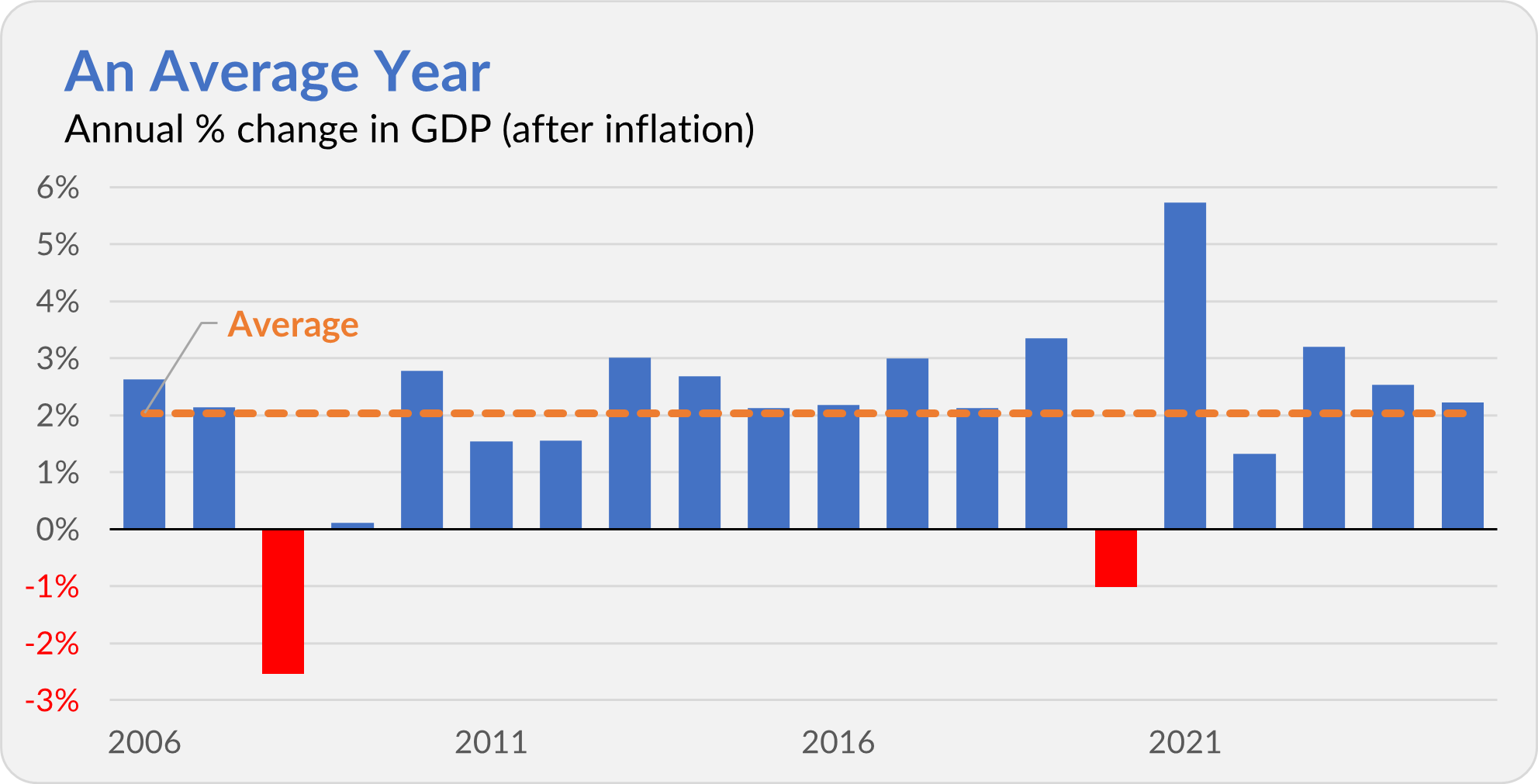
But GDP is a rearview-mirror measure. It tells us where we’ve been, not where we’re going. The takeaway: The economy absorbed the tariff disruptions without slipping into recession—but it’s not firing on all cylinders either.
That brings us back to tariffs.
Last week, the Supreme Court delivered a significant ruling, holding in a 6-3 decision that the International Emergency Economic Powers Act (IEEPA) “does not authorize the President to impose tariffs.” That effectively invalidates the administration’s trade-deficit “reciprocal” tariffs (the so-called “Liberation Day” tariffs) as well as those reportedly tied to halting trade in fentanyl.
Is that the end of the tariff story? Hardly.
The President has already signaled plans to pursue tariffs under alternative legal authorities. A new 15% global tariff has been announced, set to expire in 150 days unless Congress extends it. Legal challenges are almost certain to follow.
The larger issue isn’t any single tariff. It’s the uncertainty surrounding them.
Businesses can adapt to higher costs. What they struggle with is unpredictability—shifting rules, temporary measures and policies that may or may not survive legal scrutiny. That kind of policy fog can slow hiring and delay investment.
We’re not returning to a low-tariff, free-trade world anytime soon. Beyond that, the outlook is unclear.
The U.S. economy has proven resilient. But when uncertainty rises, growth rarely accelerates.
For investors, the playbook doesn’t change: When the outlook is cloudy, diversification is your edge. Build a portfolio that doesn’t need a perfect forecast to succeed. That’s my objective in building my Models. I hope you follow suit.
Morningstar’s Shopping List
Last week, I clicked on Morningstar’s The Best Vanguard Funds article with genuine anticipation. I always come to my own conclusions, but I was curious to see where Morningstar and I might align—and where we’d part ways.
I left disappointed—but not for the reason you might think.
Morningstar listed 29 “best” stock index funds to buy. Twenty-nine.
Look, I understand that when you’re dealing with Vanguard’s low-cost index lineup, the differences can feel subtle. I spend a lot of time splitting those hairs and telling you where I think they matter. But telling investors that nearly 30 stock index funds are “best” doesn’t narrow the field—it overwhelms it. That’s not guidance; that’s a catalog.
The fund-rater at least narrowed the field to just five bond index funds.
Just 14 actively-managed funds made the cut. But six are tax-exempt bond funds. Another, Tax-Managed Capital Appreciation (VTCIX), is essentially an index fund.
Strip those out, and you’re left with seven “best” active funds:
- Capital Opportunity (VHCOX)
- Dividend Growth (VDIGX)
- PRIMECAP (VPMAX)
- Strategic Equity (VSEQX)
- Strategic SmallCap Equity (VSTCX)
- Wellesley Income (VWINX)
- Wellington (VWELX)
Long-time readers know I think highly of PRIMECAP Management. But if PRIMECAP makes the list, why not include PRIMECAP Core (VPCCX)?
And how does not a single foreign stock fund qualify? Not even International Core Stock (VWICX), which ranks in the top decile of its peer group over the past five years?
Morningstar has kept Dividend Growth on its “best” list, while I sold it last year. That’s fine—we won’t always see eye to eye.
Reasonable people can disagree. That’s what makes markets.
But when nearly every box on the shelf is labeled “best,” the word loses meaning. Investors don’t need a long shopping list. They need clarity, conviction and context.
Investor Choice Expands (Again)
Just as I was about to publish this Weekly Brief, Vanguard announced it is adding 17 more funds to its Investor Choice program—bringing in all of its sector index funds and the rest of its S&P-based U.S. stock index funds.
The program, run in partnership with Broadridge Financial Solutions, allows mutual fund and ETF shareholders to choose how their proxy votes are cast for the companies their funds own.
Here’s a list of the funds joining the program:
- Communication Services Index (VTCAX or VOX)
- Consumer Discretionary Index (VCDAX or VCR)
- Consumer Staples Index (VCSAX or VDC)
- Energy Index (VENAX or VDE)
- Financials Index (VFAIX or VFH)
- Health Care Index (VHCIX or VHT)
- Industrials Index (VINAX or VIS)
- Information Technology Index (VITAX or VGT)
- Materials Index (VMIAX or VAW)
- Utilities Index (VUIAX or VPU)
- S&P 500 Value ETF (VOOV)
- S&P Mid-Cap 400 ETF (IVOO)
- S&P Mid-Cap 400 Growth ETF (IVOG)
- S&P Mid-Cap 400 Value ETF (IVOV)
- S&P Small-Cap 600 ETF (VIOO)
- S&P Small-Cap 600 Growth ETF (VIOG)
- S&P Small-Cap 600 Value ETF (VIOV)
And here are the funds already participating:
- 500 Index (VFIAX or VOO)
- Dividend Appreciation Index (VDADX or VIG)
- ESG U.S. Stock ETF (ESGV)
- Extended Market Index (VEXAX or VXF)
- Growth Index (VIGAX or VUG)
- High Dividend Yield Index (VHYAX or VYM)
- Institutional Index (VINIX)
- LargeCap Index (VLCAX or VV)
- Mega Cap ETF (MGC)
- MidCap Index (VIMAX or VO)
- Russell 1000 ETF (VONE)
- S&P 500 Growth ETF (VOOG)
- Tax-Managed Capital Appreciation (VTCLX)
- Tax-Managed Small-Cap (VTMSX)
- Value Index (VVIAX or VTV)
How it works
You’re not voting on each proxy yourself. Instead, you select one of five preset voting policies that Vanguard will follow on your behalf:
- The Vanguard-Advised Funds Proxy Voting: Vanguard continues voting your shares as it always has.
- Company Board-Aligned: Vote with company management. If the board makes no recommendation, you abstain.
- Glass Lewis ESG: Follow the recommendations of Glass Lewis—a third-party proxy advisor with an environmental, social and governance (ESG) focus. (Read more here.)
- Egan-Jones Wealth-Focused: Follow Egan-Jones—another third-party proxy advisor—which emphasizes maximizing shareholder value and generally rejects ESG-related proposals. (Read more here.)
- Mirror Voting: Your votes match those cast by other participating shareholders in the Broadridge network.
Should You Participate?
If you’re comfortable with how Vanguard has historically voted proxies, there’s no pressing need to enroll.
I signed up for Investor Choice in 2024. As I wrote then, the process was straightforward and intuitive—one of the rare instances where Vanguard truly nailed the technology and user experience.
Vanguard’s goal is to bring all of its index funds into the program. Since each sub-adviser votes its own shares, I wouldn’t expect actively managed funds to join. But for index investors, the opportunity to have a more direct say continues to expand.
And whether you plan to participate or not, that’s a meaningful shift in how Vanguard balances scale, stewardship and investor voice.
Our Portfolios
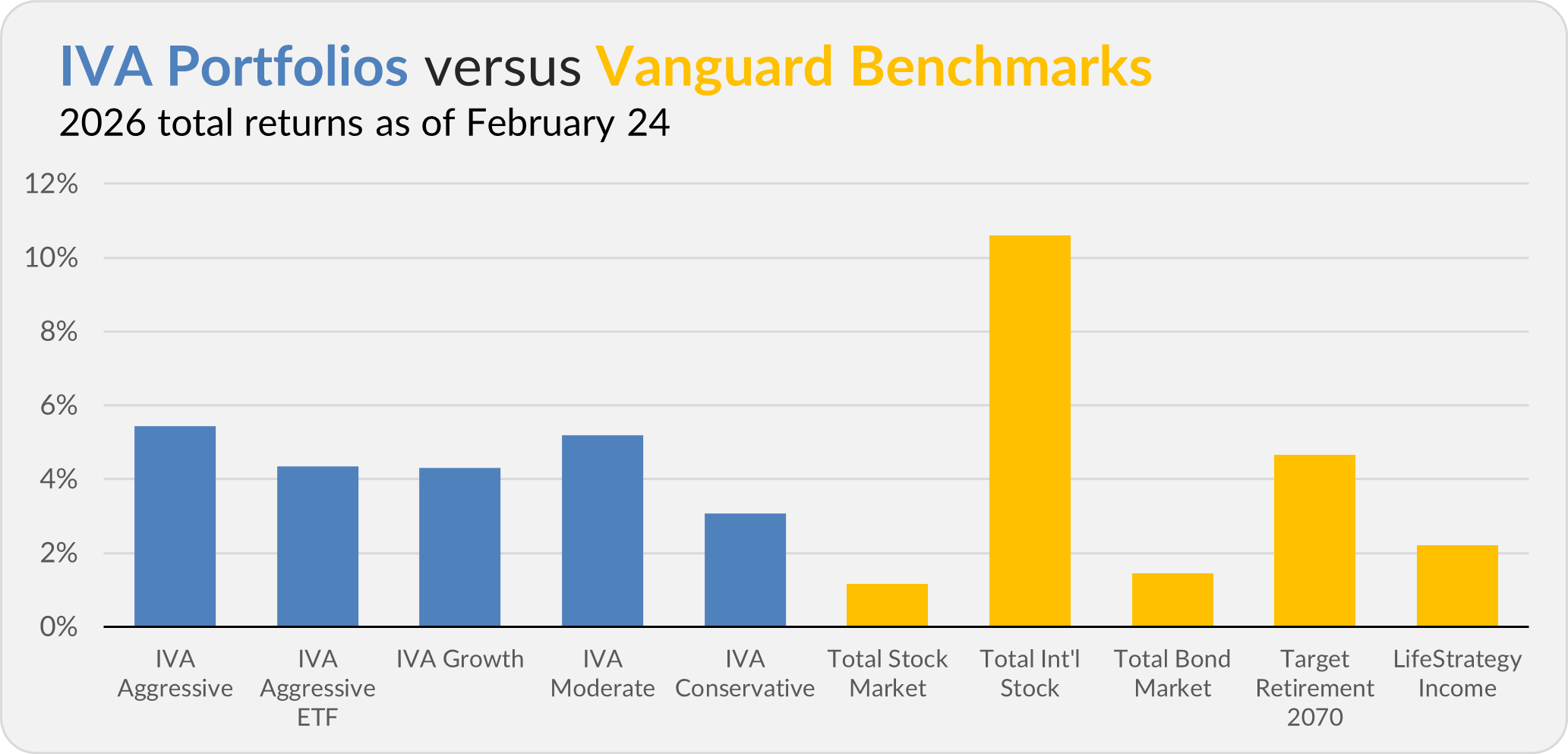
Our Portfolios are showing solid returns for the year through Tuesday. The Aggressive Portfolio is up 5.4%, the Aggressive ETF Portfolio is up 4.4%, the Growth Portfolio is up 4.3%, the Moderate Portfolio is up 5.2% and the Conservative Portfolio is up 3.1%.
This compares to a 1.2% gain for Total Stock Market Index (VTSAX), a 10.6% return for Total International Stock Index (VTIAX), and a 1.4% gain for Total Bond Market Index (VBTLX). Vanguard’s most aggressive multi-index fund, Target Retirement 2070 (VSNVX), is up 4.7% for the year, and its most conservative, LifeStrategy Income (VASIX), is up 2.2%.
IVA Research
Yesterday, I showed Premium Members exactly how I’m allocating my own money—eating my own cooking right alongside you.
Until my next IVA Weekly Brief, have a safe, sound and prosperous investment future.
Still waiting to become a Premium Member? Want to hear from us more often, go deeper into Vanguard, get our take on individual Vanguard funds, access our Portfolios and Trade Alerts, and more? Start a free 30-day trial now.
Vanguard and The Vanguard Group are service marks of The Vanguard Group, Inc. Tiny Jumbos, LLC is not affiliated in any way with The Vanguard Group and receives no compensation from The Vanguard Group, Inc.
While the information provided is sourced from sources believed to be reliable, its accuracy and completeness cannot be guaranteed. Additionally, the publication is not responsible for the future investment performance of any securities or strategies discussed. This newsletter is intended for general informational purposes only and does not constitute personalized investment advice for any subscriber or specific portfolio. Subscribers are encouraged to review the full disclaimer here.