

Hello, and welcome to the IVA Weekly Brief for Wednesday, April 22.
There are no changes recommended for any of our Portfolios.
The market moved on—fast.
500 Index (VFIAX) fell 7.7% in the first 21 trading days following the U.S. and Israel’s coordinated attack on Iran. Since then—despite an unresolved conflict—the flagship index fund has rallied 11.5%%, pushing to new highs.
Yes, President Trump has extended the ceasefire indefinitely. But the latest round of peace talks fell apart before they began, the Strait of Hormuz remains blocked and the conflict could reignite at any time.
What happens next is anyone’s guess. And, well, I’m not a geopolitical strategist—nor a short-term trader—so I’m not going to play that guessing game.
However, what stands out in this rebound is the shift in market leadership—or rather, the return of technology and AI stocks to the front of the pack.
In the first quarter, Value Index (VVIAX) outperformed Growth Index (VIGAX) each month. In April, that flipped. Growth Index is up 12.0%, while Value Index has gained 3.4%. Information Technology ETF (VGT) has led the way, rising 15.8%.
Yes, value stocks still lead for the year—6.9% to 0.3%. But the AI rally, at least for now, clearly has legs.
Market leadership isn’t the only open question.
Yesterday, the Senate Banking Committee held a confirmation hearing for Kevin Warsh, the President’s pick to lead the Federal Reserve (Fed). His path forward is uncertain, tied in part to the criminal probe involving the Fed’s construction project and Senator Tillis’s refusal to support any nominee until the probe is resolved.
Meanwhile, Jerome Powell’s term as Fed Chair ends May 15. If no successor is confirmed, will he stay on? Probably. And while Fed chairs typically step down from the Board when their term ends, Powell could remain through 2028.
Whoever occupies the chair won’t have it easy.
Inflation has run above the Fed’s 2% target for years. The conflict in Iran could push it higher, though that may (or may not) be temporary. Add in questions about AI-driven productivity and the strength of the labor market, and the Fed faces a long list of unknowns.
So what’s the takeaway?
Leadership—in markets and in Washington—is rarely settled for long. Growth is back on top (for now), the Fed’s future is uncertain and the geopolitical backdrop remains fragile.
That’s a lot of uncertainty.
It’s also normal.
And the market, as it tends to do, keeps moving forward anyway.
Vanguard Plays Catch Up as ETFs Split
Yesterday, as planned, Vanguard split the shares for five stock index ETFs:
- Growth ETF (VUG): 6-for-1 split
- MegaCap Growth ETF (MGK): 5-for-1 split
- S&P 500 Growth ETF (VOOG): 6-for-1 split
- MidCap ETF (VO): 4-for-1 split
- Information Technology ETF (VGT): 8-for-1 split
On Tuesday, the prices of those ETFs dropped sharply—as expected.
However—and this is key—shareholders also received additional shares. The value of your investment didn’t change (aside from normal market moves).
In short: Lower price. More shares. Same value.
That said, if you were watching in real time, Vanguard’s systems took a while to catch up.
I heard from several IVA readers on Tuesday morning who saw prices fall but hadn’t yet received the additional shares in their accounts. Not a great look.
When I checked my own account (which holds a few shares of every Vanguard ETF) midday, the share counts had updated—but the cost basis hadn’t. For a time, it looked like I was sitting on losses of 60% to 75%.
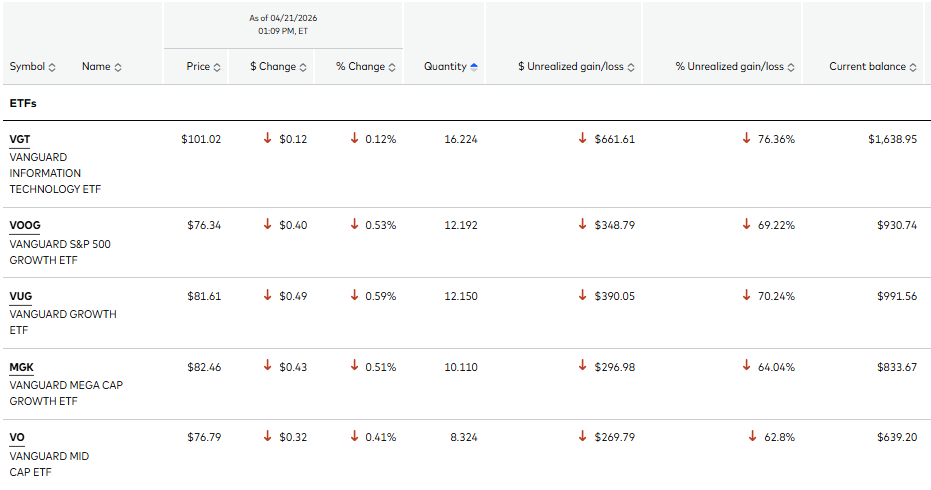
By Wednesday morning, Vanguard’s system had caught up and everything reflected correctly.
So yes, the system got there in a reasonable amount of time. But a simple note flagging the stock splits could have saved investors a fair amount of confusion. By contrast, Fidelity’s brokerage system flagged the changes directly in client accounts.
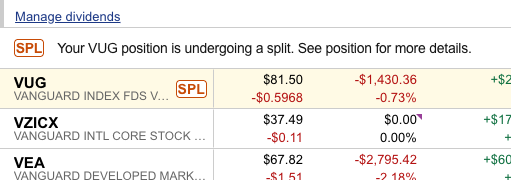
The bottom line: Vanguard’s tech is still playing catch-up. As for ETF (stock) splits, Vanguard has done this before and likely will again—but a stock split isn’t a reason to buy or sell.
Vanguard Names Co-Managers… But Not for Barrickman
Last week, Vanguard’s fixed income team added co-managers across several funds—including its taxable money market and investment-grade bond funds.
What stood out to me wasn’t just the additions—it was who was added.
Several of the new co-managers are relatively new to Vanguard itself:
- Blanton Keh brings 25 years of industry experience but joined the firm in 2025.
- Manuel Hayes has 21 years of experience but joined Vanguard in 2025.
- Elon D’Anjou has two decades in the business and arrived this year.
This is yet another example of Vanguard’s growing willingness to recruit experienced talent from outside the firm for key roles.
In many ways, adding co-managers makes sense. It builds redundancy, develops the next generation of leaders and reduces key-person risk. You see that logic reflected across many of Vanguard’s stock index funds.
Which is why it’s still striking that Joshua Barrickman remains the sole listed portfolio manager on most of Vanguard’s bond index funds and ETFs.
Yes, Core-Plus Bond Index ETF (BNDP) picked up a co-manager—but many of Vanguard’s flagship bond index products still rely on Barrickman alone. In a firm that clearly values depth and succession planning on the equity side, that concentration stands out.
ETF Launch Reminder:
Vanguard launched Developed Markets ex-U.S. Growth Index ETF (VDG) and Developed Markets ex-U.S. Value Index ETF (VDV) last Thursday.
I already shared my quick take and full take on these ETFs—and how they stack up against Vanguard’s legacy actively managed funds—with Premium Members.
Our Portfolios
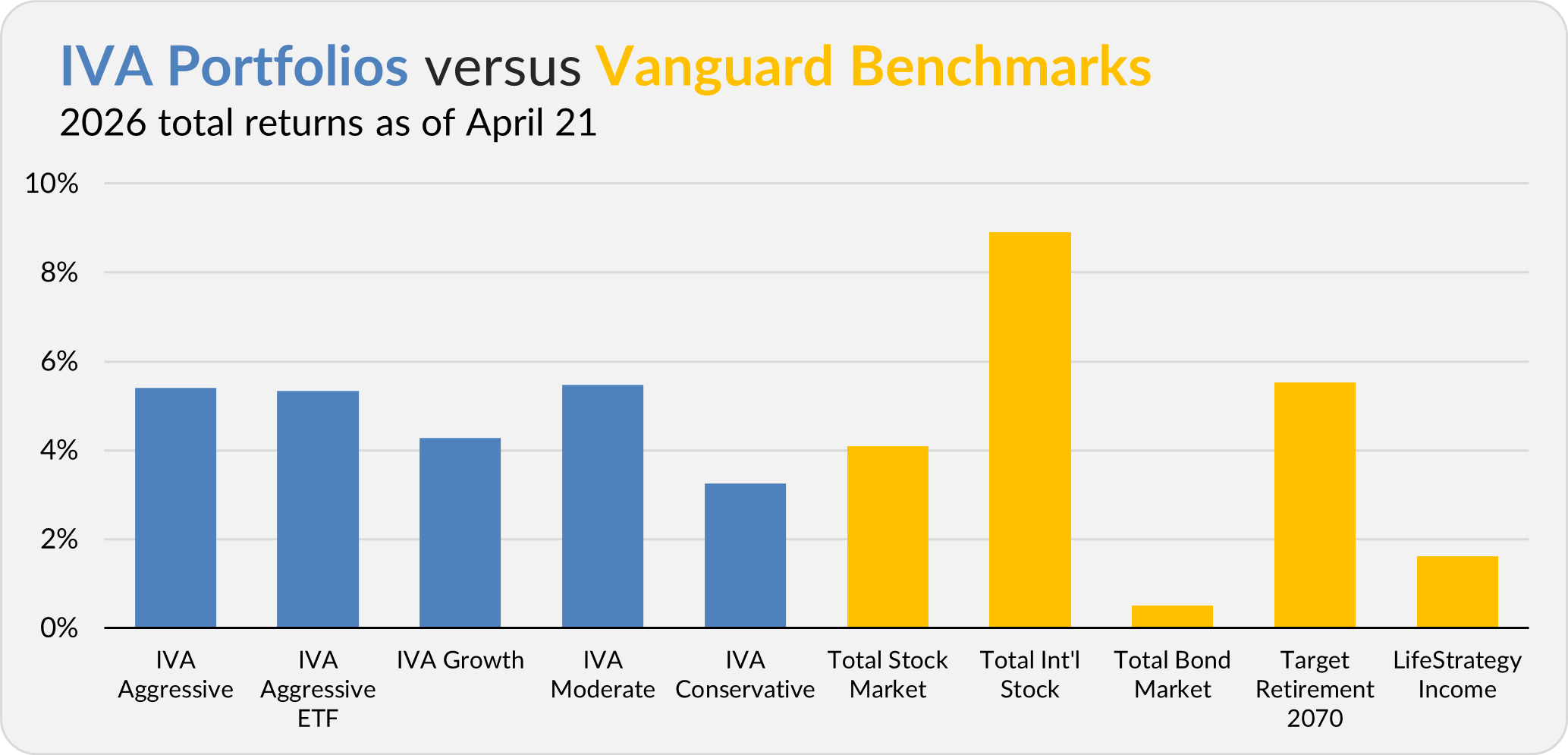
Our Portfolios are showing solid returns for the year through Tuesday. The Aggressive Portfolio is up 5.4%, the Aggressive ETF Portfolio is up 5.3%, the Growth Portfolio is up 4.3%, the Moderate Portfolio is up 5.5% and the Conservative Portfolio is up 3.2%.
This compares to a 4.1% gain for Total Stock Market Index (VTSAX), an 8.9% return for Total International Stock Index (VTIAX), and a 0.5% gain for Total Bond Market Index (VBTLX). Vanguard’s most aggressive multi-index fund, Target Retirement 2070 (VSNVX), is up 5.5% for the year, and its most conservative, LifeStrategy Income (VASIX), is up 1.6%.
IVA Research
Yesterday, I shared a deep dive into Vanguard’s Charitable Endowment Program with Premium Members. The pitch sounds simple—give now, decide later—but there’s more going on under the hood.
In particular, Vanguard has added a private-investment option run by the same outfit (Hamilton Lane) that failed in its first attempt to bring private-market funds to Vanguard’s high-net-worth investors. I’d stay clear of this expensive fund.
Until my next IVA Weekly Brief, have a safe, sound and prosperous investment future.
Still waiting to become a Premium Member? Want to hear from us more often, go deeper into Vanguard, get our take on individual Vanguard funds, access our Portfolios and Trade Alerts, and more? Start a free 30-day trial now.
Vanguard and The Vanguard Group are service marks of The Vanguard Group, Inc. Tiny Jumbos, LLC is not affiliated in any way with The Vanguard Group and receives no compensation from The Vanguard Group, Inc.
While the information provided is sourced from sources believed to be reliable, its accuracy and completeness cannot be guaranteed. Additionally, the publication is not responsible for the future investment performance of any securities or strategies discussed. This newsletter is intended for general informational purposes only and does not constitute personalized investment advice for any subscriber or specific portfolio. Subscribers are encouraged to review the full disclaimer here.