

Hello, and welcome to the IVA Weekly Brief for Wednesday, November 11.
There are no changes recommended for any of our Portfolios.
Let’s start with Vanguard news and then turn to the markets.
Vanguard Hacked?
Yes—but not on the scale the headlines suggest.
Vanguard confirmed to me that it suffered a “social engineering” incident—cybersecurity-speak for tricking a person, often with a convincing phone call or email, into handing over access. In this case, that gave an outsider access to a cloud-based business application (think Microsoft 365) and exposed personal information for what Vanguard described as a small percentage of its clients—mostly participants in workplace retirement plans, like 401(k)s.
Vanguard told me no client accounts were accessed and its operations weren’t disrupted. Letters to affected individuals, a couple hundred thousand clients according to the company—including an offer of free credit monitoring—are going out this week, and the firm is working with plan sponsors to reach participants.
A couple hundred thousand is a far cry from the more than 14 million records a hacker claimed on a dark web forum in October—the figure a class action lawsuit filed last Friday, Peppard v. The Vanguard Group, leans on. (Records and people aren’t the same thing, so the two numbers may not line up neatly.) Before now, the only reliable public trace of the incident was a November 4 filing with Vermont’s attorney general covering 94 residents whose Social Security numbers were affected.
What Can You Do?
If your information was exposed, you should hear from Vanguard (or your employer’s plan) soon. Either way, a few precautions are worth taking.
- Watch your mail. If you get a notice, read it closely and take Vanguard up on its credit-monitoring offer.
- Don’t count on the phone line. Vanguard’s brokerage reps may not know about this. One told an IVA reader she had seen no notice of a breach, since she would only be alerted to problems on the retail side—not in workplace retirement plans, where this incident was concentrated. If you have both types of accounts, don’t take a “no” from one side as the final word.
- Be skeptical of any call, text or email “from Vanguard.” This breach started with someone being tricked, and exposed personal information makes the next scam more convincing. If in doubt, hang up and call the number on Vanguard’s website.
- Freeze your credit at Equifax, Experian and TransUnion. It’s free, and it’s the best defense if your Social Security number is out there.
- Use a passkey or QR-code login rather than text-message codes. I’ve long had a strong password and two-factor authentication on my Vanguard account, but these days I log in by scanning a QR code and verifying it on my phone. I’ve also set up a passkey.
The bottom line: Vanguard has spent heavily on technology in recent years, but social engineering targets people, not systems—and no budget fully closes that gap. Vanguard is following the standard playbook to investigate, notify and offer credit monitoring. Still, by saying nothing publicly while a 14-million-record claim made the rounds, the firm let the worst-case version become the story.
Official Distribution Estimates
Vanguard has posted its official estimates for year-end capital gains distributions—and, credit where it’s due, they’re on the investor site, not locked behind the advisor login I complained about two weeks ago.
I’ll dig into the estimates next week, but they largely confirm what I told you then: Vanguard’s actively managed stock funds are on pace for their biggest payouts in more than two decades. More to come.
If Vanguard Builds It …
The expansion is complete; now to boost participation.
Vanguard recently announced that in early 2027, all of its U.S. stock index funds as well as the LifeStrategy and Target Retirement funds will be part of the firm’s Investor Choice program.
The program, run in partnership with Broadridge Financial Solutions, allows mutual fund and ETF shareholders to choose how their proxy votes are cast for the companies their funds own.
You’re not voting on each proxy yourself. Instead, you select one of five preset voting policies that Vanguard will follow on your behalf:
- Vanguard-Advised Funds Policy: Vanguard continues voting your shares as it always has.
- Company Board-Aligned: Vote with company management. If the board makes no recommendation, you abstain.
- Glass Lewis ESG: Follow the recommendations of Glass Lewis—a third-party proxy advisor with an environmental, social and governance (ESG) focus. (Read more here.)
- Egan-Jones Wealth-Focused: Follow Egan-Jones—another third-party proxy advisor—which emphasizes maximizing shareholder value and generally rejects ESG-related proposals. (Read more here.)
- Mirror Voting: Your shares are voted in roughly the same proportions as other shareholders’ votes in the Broadridge network.
Here’s a list of the funds (and annuities) joining the program early next year:
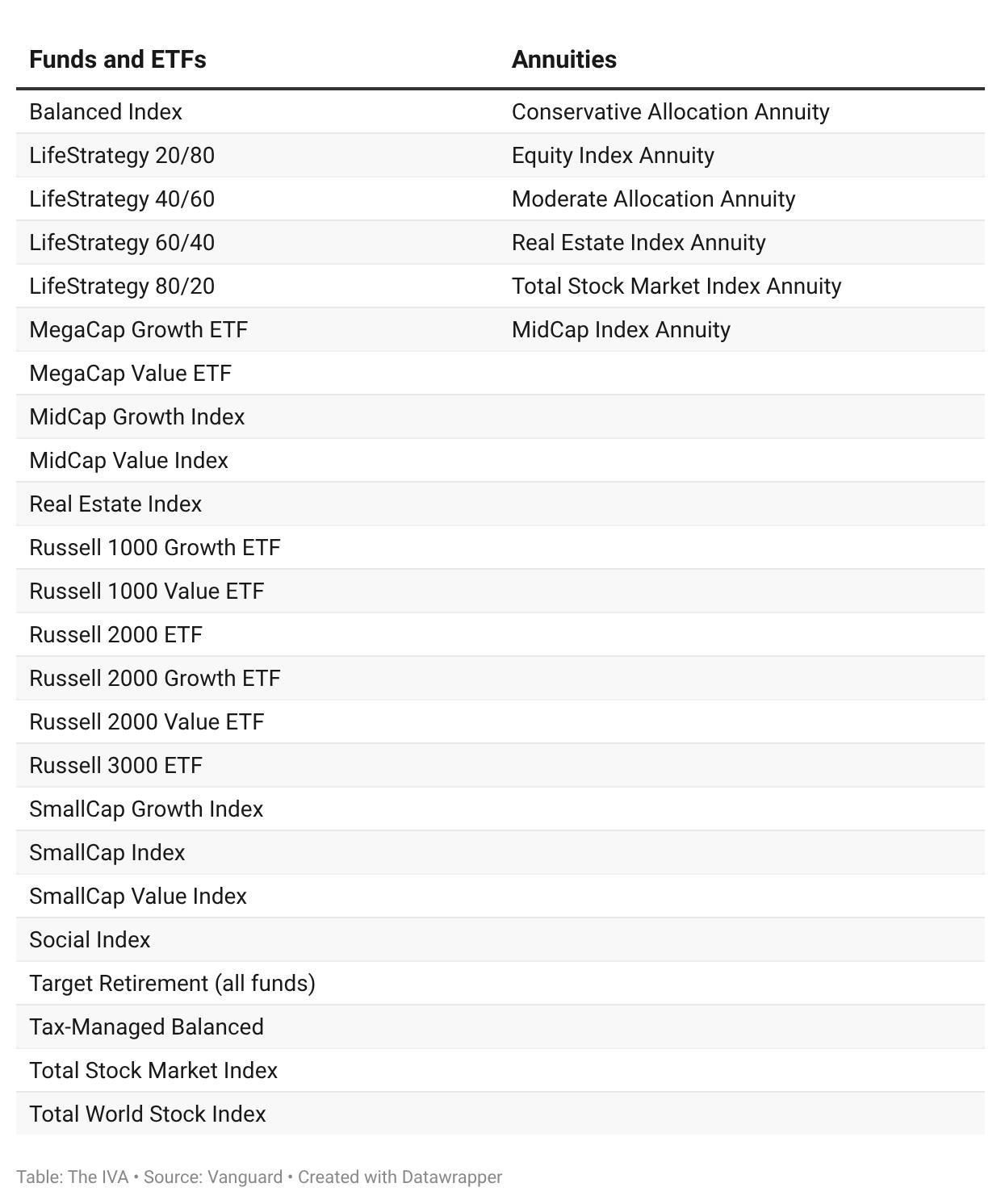
Total Stock Market Index (VTSAX), with more than $2 trillion in assets, is the program's biggest addition.
Vanguard says that while these additions represent “the completion of Vanguard's planned U.S. expansion of the program, future Vanguard products that meet Investor Choice's eligibility criteria will also become eligible for participation.”
What about the firm’s actively managed funds? They’re not participating. My read: With each sub-adviser voting its own shares, adding active funds to the program would be far more complicated.
Should You Participate?
If you’re comfortable with how Vanguard has historically voted proxies, you don’t need to enroll. If you’d rather vote with management, or you have a view on ESG proposals, it takes five minutes to enroll and make your voice heard.
I signed up for Investor Choice in 2024. As I wrote then, the process was straightforward and intuitive—one of the rare instances where Vanguard truly nailed the technology and user experience.
The numbers show that the program is growing. According to Vanguard: “From July 2025 to July 2026, participating fund shareholders increased from 82,000, representing $9 billion in assets under management, to 507,000, representing $151.3 billion.”
Nice growth, and some big numbers. But the same report says that $4 trillion is eligible to participate, which means less than 4% of assets are taking advantage.
So, now that Vanguard has built it, will they (investors) come? Time will tell.
A New Wrapper
Vanguard hit the snooze button twice, but Emerging Markets Bond Active ETF (VEMB) should start trading in the next few days. It’s a nice addition to Vanguard’s bond ETF lineup.
The ETF is a separate fund, not a share class of Emerging Markets Bond (VEMBX), but it’s run by the same managers and with a similar strategy. At 0.35%, the ETF’s expense ratio matches the mutual fund’s Admiral shares ($50,000 minimum) and undercuts its Investor shares (0.50%).
I’m on the record calling Emerging Markets Bond one of Vanguard’s best foreign bond funds. The ETF opens it up to smaller investors at the Admiral-shares price.
That’s a win. Just don’t expect a big tax advantage: Bond funds rarely pay meaningful capital gains, and the income is taxable either way. The real draws are its low cost and proven managers.
Stepping Away
Around December 21, Sprucegrove Investment Management will stop managing the roughly one-third of International Value (VTRIX) it has overseen since 2020. The twist? The decision appears to be Sprucegrove’s. According to a prospectus supplement filed yesterday, Sprucegrove “notified the Fund of its intention to terminate its investment advisory agreement.
Usually it’s Vanguard showing a sub-adviser the door. I can’t recall the last time a manager walked away on its own.
What this means for International Value isn’t yet clear. Vanguard could simply hand the assets Sprucegrove oversaw to the two remaining sub-advisers, ARGA and Altrinsic, or hire a replacement. When I last ran the numbers, Sprucegrove looked to be the weak link in the lineup, so this could be a step in the right direction. Still, my Hold rating stays—International Value is a fine fund, but it’s not compelling.
Pop Quiz
Which Vanguard sector fund is down the most this month?
Given last week’s headlines about AI stocks falling out of bed—NVIDIA and Micron Technology are both off around 18% so far in November—you’re forgiven if you guessed Information Technology ETF (VGT). But the tech ETF is off 5.5% this month. That’s not great. But it’s a heck of a lot better than the correct answer: Energy ETF (VDE), which is down 11.5% as oil and gas prices have fallen.
To be fair, the media’s focus on tech isn’t misplaced. Tech stocks make up over 40% of Total Stock Market ETF (VTI), while energy stocks are less than 4%. A smaller drop in tech can do more damage to your portfolio than a bigger drop in energy.
And if last Thursday rattled you, consider this: 500 Index (VFIAX) fell 4.4% that day—past the threshold of what I call the 3.5% Solution. Historically, buying 500 Index after a one-day drop of 3.5% or more has led to an average 12-month return of 24.7%. That’s not a promise, and I’m not trying to call a bottom. But history suggests days like last Thursday are more often opportunities than warnings.
That’s the point of the quiz: Headlines rarely give you the full picture. Don’t let the noise keep you from spending time in the market.
Our Portfolios
Our Portfolios are showing solid gains for the year through Tuesday. The Aggressive Portfolio is up 13.0%, the Aggressive ETF Portfolio is up 10.8%, the Growth Portfolio is up 11.9%, the Moderate Portfolio is up 11.3% and the Conservative Portfolio is up 7.3%.
This compares to an 11.2% return for Total Stock Market Index (VTSAX), a 10.2% gain for Total International Stock Index (VTIAX), and a 0.7% decline for Total Bond Market Index (VBTLX). Vanguard’s most aggressive multi-index fund, Target Retirement 2070 (VSNVX), is up 9.7% for the year, and its most conservative, LifeStrategy 20/80 (VASIX), is up 2.0%.

IVA Research
Yesterday, I took Premium Members inside PRIMECAP Odyssey Discovery ETF (POMG)—same stock pickers, smaller stocks—and explained why I’m buying it.
Until my next IVA Weekly Brief, have a safe, sound and prosperous investment future.
Still waiting to become a Premium Member? Want to hear from us more often, go deeper into Vanguard, get our take on individual Vanguard funds, access our Portfolios and Trade Alerts, and more? Start a free 30-day trial now.
Vanguard and The Vanguard Group are service marks of The Vanguard Group, Inc. Tiny Jumbos, LLC is not affiliated in any way with The Vanguard Group and receives no compensation from The Vanguard Group, Inc.
While the information provided is sourced from sources believed to be reliable, its accuracy and completeness cannot be guaranteed. Additionally, the publication is not responsible for the future investment performance of any securities or strategies discussed. This newsletter is intended for general informational purposes only and does not constitute personalized investment advice for any subscriber or specific portfolio. Subscribers are encouraged to review the full disclaimer here.